I just came across this post for the second time (it was originally published on a website last fall, and the author has just re-visited it on her blog.
Talking to Kids about Disability on What Do You Do, Dear?
[If you like to find new blogs and go back and read them from the beginning, I suggest you get some time and Kleenex and do so with this one. I just think she writes with the most wonderful voice.]
If you're here because you have young children, or you know young children, or you are a human, I think you should read this. It is written from her perspective as the mother of a child with spina bifida, but it is about all of us. It's about how we talk about abilities and difference, and how we talk to our children about those things, and the messages it sends when we don't talk about them well or--worse--don't even talk about them at all. Plus a Harry Potter reference.
I found myself thinking about this exact issue lately, and then this post popped up in front of me--funny how that happens, right? Like the universe knew I needed to read it again. C is still too young to stare or ask questions about differences, but I did see him look a little longer at a person using a wheelchair in Target this week, and then again at the mall yesterday. It made me self-check my own behavior, think about this, and consider what I will say when he asks questions. I know he will, because he is curious and observant and empathetic. I have worked with enough families and children in the special needs community to know I want to be thoughtful about his questions, but I hope I have enough grace in the moment(s) to speak out loud the way I've rehearsed in my head (somehow...I never do...).
How do you strike the balance between sensitive and factual? How are you thoughtful without pitying? How can we talk about difference without somehow implying that different is always bad?
One of the things I love about this post is that, in addition to her own feelings and experience, she also provides some concrete phrases and scripts. Of course, she doesn't claim that she encompasses everyone's experience or is a voice for all, but I think this is a very solid roadmap.
Talking to Kids about Disability (with links to more posts at the end, including one from Mr. Rogers--one of my first loves)
Have you ever been in a situation like this, or with a child? What do those of you who work with children have to add to this?

Showing posts with label early childhood education. Show all posts
Showing posts with label early childhood education. Show all posts
Sunday, September 7, 2014

Friday, March 28, 2014
The Red Balloon
On Tuesday, when I picked C up from school, the director stopped me in the hall and told me this sweet story.
One of the older classrooms has been "studying"/exploring light and projection, so they took a field trip to the Belcourt theatre. In return, the Belcourt offered a screening of The Red Balloon at school. On Monday, the big kids came and brought "movie tickets" to all the classrooms. On Tuesday at show time, they sent "ushers" to the infant and toddler rooms to escort the babies to the movie (great project, right?).

Most of the babies got wiggly after a couple minutes, but the director told me that C and one other friend were mesmerized for the entire movie. It's like 30 minutes long. They were laughing and clapping. I guess I'm not totally shocked, as the kid is still obsessed with balloons, but it's still funny to me. And sweet that an old, simple film can still be so enthralling to young children. We don't really watch a lot of tv with him (other than sports) so it must have been a treat. It's really just the city, a little boy, the balloon, and music. He's so cultured.

One of the older classrooms has been "studying"/exploring light and projection, so they took a field trip to the Belcourt theatre. In return, the Belcourt offered a screening of The Red Balloon at school. On Monday, the big kids came and brought "movie tickets" to all the classrooms. On Tuesday at show time, they sent "ushers" to the infant and toddler rooms to escort the babies to the movie (great project, right?).
(I'm pretty sure everyone watched this in school at some point, but if
you don't remember it, the whole thing is on YouTube)
Most of the babies got wiggly after a couple minutes, but the director told me that C and one other friend were mesmerized for the entire movie. It's like 30 minutes long. They were laughing and clapping. I guess I'm not totally shocked, as the kid is still obsessed with balloons, but it's still funny to me. And sweet that an old, simple film can still be so enthralling to young children. We don't really watch a lot of tv with him (other than sports) so it must have been a treat. It's really just the city, a little boy, the balloon, and music. He's so cultured.
Saturday, February 2, 2013
Book Shower
Earlier in January, some lovely ladies from our research project got together and hosted a little shower. As we are all early childhood people, it only made sense for them to go with a children's book theme, which they executed with creativity and enthusiasm.


All the guests brought a book for Baby C, and/or a dish to share. All the dishes tied in with a particular book. It was so fun to see everyone's creative ideas, and of course the food was tasty as well!


These custom cookies were done by the lovely lady who runs Dozen bakery here in Nashville. She makes all sorts of delicious things, and can do almost anything you can imagine for the custom decorated sugar cookies. Check out her website or Facebook page if you're in the market for something good-looking and good-tasting (made with local, organic ingredients to boot)


Obviously I had to eat everything. But the best part was coming home with a basket full of classic books to jump start C's library (and the shelf on which they'll be displayed). When the child turns out to be brilliant, we'll know that we can thank the Peabody team for giving him an early start at geniusing.
If you want a list of the books that the early childhood experts deem gift-worthy, I can add that in too.
Monday, November 12, 2012
Best Toys: The First Year
If you want to read the first installment (Best Toys Across Ages), click here.
I'll speed through the lecture from Child Development 101 to just give a brief overview of what's going on the first year. Essentially, babies are learning about and interacting with the new world around them. This includes the obvious progression toward the development of language as well as the gross motor (large muscle) skills like rolling, sitting, creeping/crawling, and eventually walking. But from a play or toy standpoint, the most salient trends are the development of reaching, grabbing, and manipulating the environment.
You can see this progress from random flailing and reflexes to emerging control of arms and hands, with attempts at intentional reaching or batting (around approximately 4 months). From there, that progresses to definite reaching and grabbing (say, your hair). Then it's all about refining the grasp and moving with purpose. Around the end of the first year, you'll see the "pincer grasp" (think: picking up Cheerios) in addition to the whole-hand grab. This progression to the pincer grasp is important because it leads to breakthroughs in self-help skills--such as feeding oneself--and will be important for holding a writing implement and other tools down the road.
Ideally, that quick lesson will help explain the common threads between the items that seem to be most popular with this age.
First up: a list from elsewhere on the interwebs detailing what one person suggests are the best toys for boosting development during the first year. While it's true that anyone on the internet can have an opinion, this woman is an occupational therapist--meaning she focuses on those fine motor/small muscle movements--and knows what she's talking about. So in lieu of reinventing the wheel, I'm sharing and crediting her work.




I'll speed through the lecture from Child Development 101 to just give a brief overview of what's going on the first year. Essentially, babies are learning about and interacting with the new world around them. This includes the obvious progression toward the development of language as well as the gross motor (large muscle) skills like rolling, sitting, creeping/crawling, and eventually walking. But from a play or toy standpoint, the most salient trends are the development of reaching, grabbing, and manipulating the environment.
You can see this progress from random flailing and reflexes to emerging control of arms and hands, with attempts at intentional reaching or batting (around approximately 4 months). From there, that progresses to definite reaching and grabbing (say, your hair). Then it's all about refining the grasp and moving with purpose. Around the end of the first year, you'll see the "pincer grasp" (think: picking up Cheerios) in addition to the whole-hand grab. This progression to the pincer grasp is important because it leads to breakthroughs in self-help skills--such as feeding oneself--and will be important for holding a writing implement and other tools down the road.
Ideally, that quick lesson will help explain the common threads between the items that seem to be most popular with this age.
First up: a list from elsewhere on the interwebs detailing what one person suggests are the best toys for boosting development during the first year. While it's true that anyone on the internet can have an opinion, this woman is an occupational therapist--meaning she focuses on those fine motor/small muscle movements--and knows what she's talking about. So in lieu of reinventing the wheel, I'm sharing and crediting her work.
I'll just highlight and expand on a few things she says.
Books.
It's worth repeating, because you really can't have too many. And, unlike play gyms, it doesn't really matter if baby already has one. Variety is the spice of life. If you're unsure about what baby might already have in his library, don't worry about it. Duplication is even welcome, because you can keep one in the diaper bag/car/wherever. Babies thrive on the repetition of reading, so having two Goodnight Moon board books isn't going to hurt anyone.
Need some direction?
- Parenting.com has a list of the Top 25 Books for Baby - this wouldn't be my Top 25 exactly, but the classics are on there and you can't go wrong.
- How well do you know the parent? This is one of those "why didn't I think of that??" moments:
mom and dad will chuckle, if nothing else (it's for the parents, obviously). Tip: search for it just as "go the f to sleep"...
These Things.
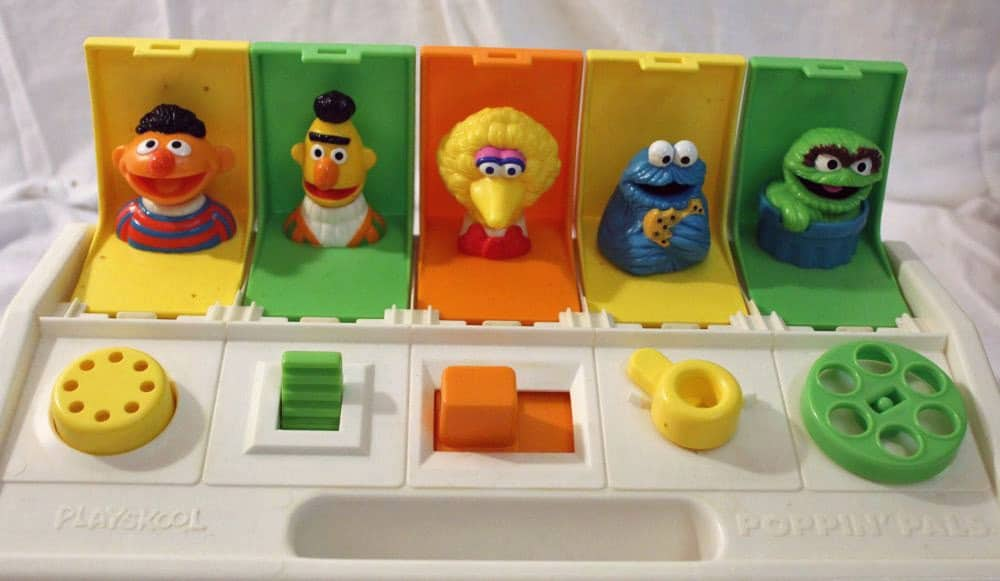
Remember these?
They're still pretty popular with the infant set. In my opinion, if something stands the test of time, it's best to assume that means it's on to something. Of course, these look a little different now, but the basic premise is the same. Babies have to learn to manipulate the levers/dials (fine motor) to see the character pop up (cause and effect). Now they come with noises and singing pals and what have you, but a classic, non-noisy one is just as good for baby--maybe better, so they don't get over stimulated--and better for your sanity. You don't need every bell and/or whistle out there, I promise.
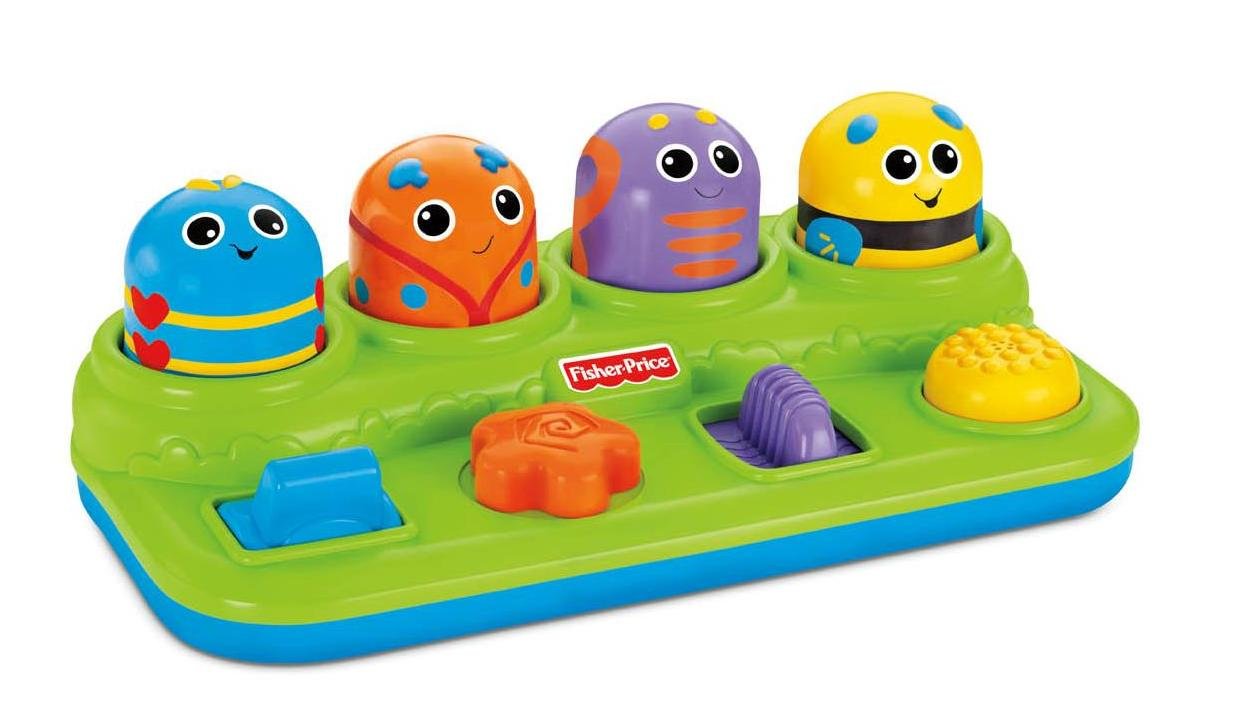
A more current version: Fisher-Price Boppin' Activity Bugs from Amazon:
Baby powered. No batteries needed!
Just search "pop up toys" on Amazon, and you'll get several options. They will also usually have these at Target and similar stores, but they might tend toward the battery-operated versions. Purchase noisy toys at your own peril, depending on how much you like the baby's parents.
Similar, but a little different: squeaky egg toy.
they love 'em.
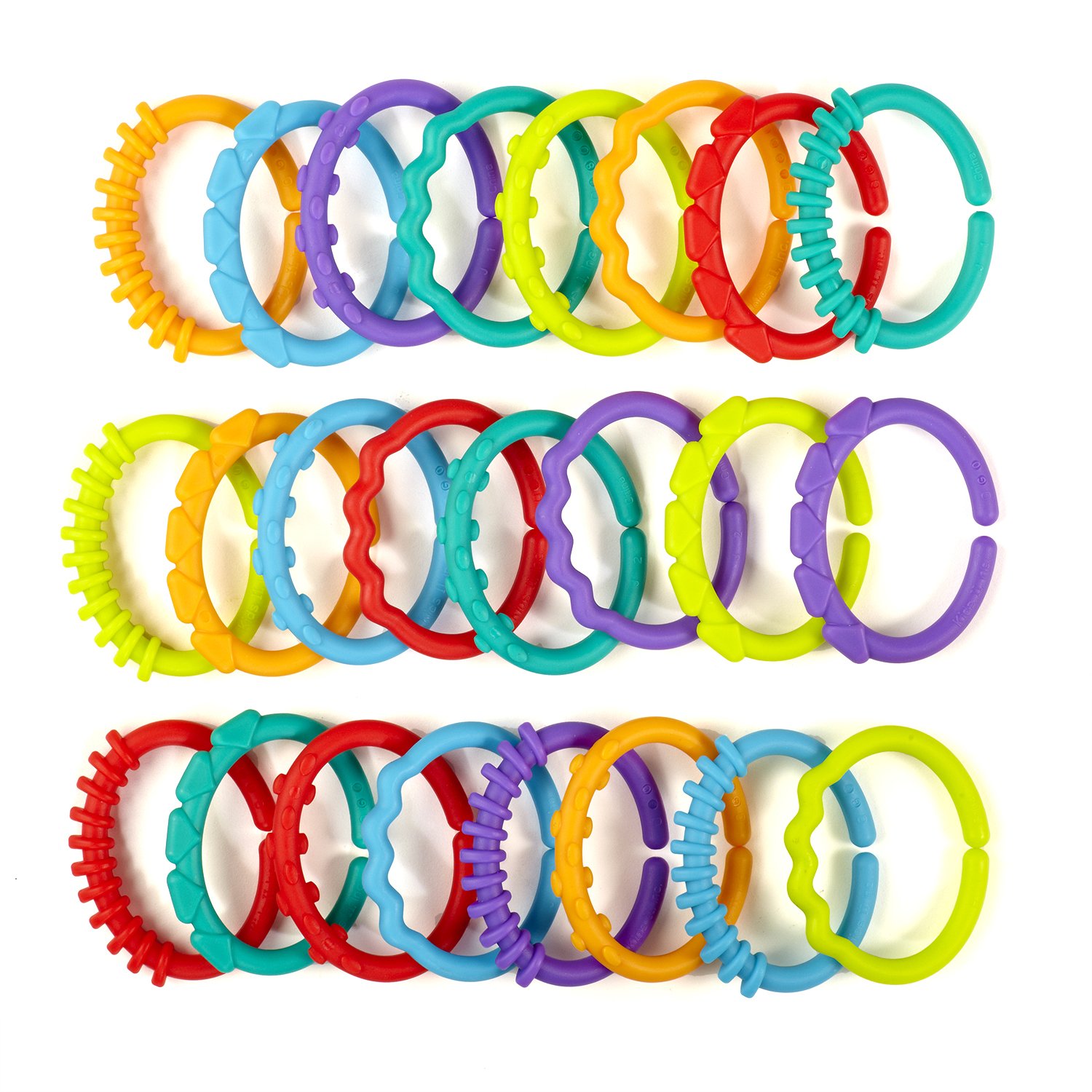
Rings/Links.
These are on the OT's list as well, but I have heard this repeated across the internet. Another blogger I read has said she will begin wrapping all baby shower gifts in these.
Even if/when baby isn't as intrigued with the rings themselves after a while, they can be used to attach more interesting toys to jumpers/carseats/what have you.
Stacking cups.
Man, babies are pretty easily entertained. At first, it probably won't be stacking or nesting, per se, but more like crashing and banging. Whatever works.
More on push toys.
Yes, these are also on the OT's list, but I had a little more to say. It doesn't have to be this one, but here is an example:
Don't be fooled by the larger, walking child. These are also good for the less mobile set because babies can also interact with them in different ways: lying on tummies, sitting, etc. That's the key thing you'll want to look for if you're interested in one of these. Ask yourself: "could a child who can't yet walk be engaged with this for a reasonable amount of time? After s/he can walk, is it still interesting (and safe)?" On the toy above, a sitting child could play with the spinning blocks or the alligators. The images on the wheels would also be engaging for a child lying at that eye level.
Search "push toy" on Amazon for more examples. FYI, my professional opinion is that the VTech ones (and similar) have too much going on and are actually overstimulating to babies without the developmental payoff. I've said it before and I'll say it again: a higher price tag (and more electronic bells and whistles) does NOT equal a higher-quality toy from a learning standpoint.
Other considerations for gift giving.
The following suggestions don't really have anything to do with promoting baby's development. However, I originally started this series with the holiday gifting season in mind. I wanted to share some other ideas that new parents might appreciate in case you don't want to go toy shopping, don't know what baby might already have, or would just like some other ideas.
- Baby clothes. Depending on how old baby is, s/he might have already outgrown a lot of the cute outfits that mom got at her baby shower. Sizing of baby clothes is not consistent, nor are the growth curves of infants. They can skip entire sizes entirely. It might be worth helping the new parents stock up in sizes that might have been overlooked. Baby's feelings won't be hurt...he's still too young to really be mad if you didn't get him a fun toy.
- iTunes gift cards. There are a lot of ways new parents can put these to use.
- Apps. There are some great ones for tracking all the things you need to track with a newborn, such as Baby Connect, which has been recommended to me by more than one new mom. Other less-baby-related apps are also helpful, like Wunderlist, which can help parents keep track of lists (e.g., grocery lists) and sync them across devices (e.g., mom's phone to dad's phone). [For the record, a more comprehensive app post is forthcoming]. They're on their iPads and phones and laptops a lot, so this is a high-value item.
- Movies and TV shows. For those middle-of-the-night feeding sessions.
- Music. Lullabies for baby, of course. Or just white noise.
- Amazon gift cards. Amazon is a lifesaver for new parents. It does the trick when a trip to Target just seems too overwhelming. Also, they can use it however they'd like: diapers, baby needs, something they've had their eye on...because Amazon has EVERYthing. Most new parents have Amazon Prime and/or Amazon Mom and are already pros at this. They'll appreciate a little addition to the diaper fund, and a gift card helps avoid the confusion of you having to pick a size.
- Babysitting. Or maybe just a bottle of wine. Or a nap.
- Check the registry. This could be more or less useful, depending on baby's age. But registries stay active for a while, even after baby's arrival. This might give you a peek into something that the parents wanted but never received.
And there you have it. Best of luck shopping for the little nugget in your life, and hopefully providing some developmental benefits in the process. Don't stress about this one too much, because at this age they are really more in to a wooden spoon, some wrapping paper, your keys, and the cat.
Any favorites for the 0-12 month set I've left off the list? Let me know in the comments!
Tuesday, October 30, 2012
Best Toys for Boosting Development
I'm going to be taking a slight detour from the usual focus around here and put on my researcher/advocate hat for a post or two.
Even though Halloween is still ahead of us, I'm seeing the initial rumblings of the holiday season. Given that many more of my friends are now parents than even this time last year, and those of you who aren't still undeniably now have more littles in your lives--I thought I'd try to capture of my thoughts on early childhood, play, and yes--toys--as you might be working on your list for Santa or Hanukkah Harry starting soon.
For some quick context: I have worked in the field of early childhood education for a decade now (OH MAN). This is longer than some, but not as long as many. I was a toddler/PreK classroom teacher for several years, after which I got a Master's degree in Human Development and Psychology. I am now in the last minutes--we're talking death rattle here--of finishing a Ph.D in Early Childhood Intervention and Special Education. As such, I have a solid foundation in child development, for typically developing children as well as children with disabilities. I focus more on the preschool age (3 - 5 years), but have infant knowledge as well. My primary research interests are children living in poverty and children with challenging behavior. The purpose of this brief resume is not to toot my own horn but to say that I sort of know what I'm talking about from many angles, with the notable exception being the experience of actually being a parent. Take that for what you will.
I wanted to take a stab at helping parents/grown up people navigate the loud and light-up world of the toy aisle, and provide a little guidance for choosing items (gifts or otherwise) for young children that a) promote growth and development, b) are a justifiable investment for the purchaser, and c) are fun for kids. I will walk through some suggestions, explaining why I think they fit the bill, and then end with a set of guiding questions to help you assess such items on your own and learn to buy with a discerning eye.
Even though Halloween is still ahead of us, I'm seeing the initial rumblings of the holiday season. Given that many more of my friends are now parents than even this time last year, and those of you who aren't still undeniably now have more littles in your lives--I thought I'd try to capture of my thoughts on early childhood, play, and yes--toys--as you might be working on your list for Santa or Hanukkah Harry starting soon.
For some quick context: I have worked in the field of early childhood education for a decade now (OH MAN). This is longer than some, but not as long as many. I was a toddler/PreK classroom teacher for several years, after which I got a Master's degree in Human Development and Psychology. I am now in the last minutes--we're talking death rattle here--of finishing a Ph.D in Early Childhood Intervention and Special Education. As such, I have a solid foundation in child development, for typically developing children as well as children with disabilities. I focus more on the preschool age (3 - 5 years), but have infant knowledge as well. My primary research interests are children living in poverty and children with challenging behavior. The purpose of this brief resume is not to toot my own horn but to say that I sort of know what I'm talking about from many angles, with the notable exception being the experience of actually being a parent. Take that for what you will.
I wanted to take a stab at helping parents/grown up people navigate the loud and light-up world of the toy aisle, and provide a little guidance for choosing items (gifts or otherwise) for young children that a) promote growth and development, b) are a justifiable investment for the purchaser, and c) are fun for kids. I will walk through some suggestions, explaining why I think they fit the bill, and then end with a set of guiding questions to help you assess such items on your own and learn to buy with a discerning eye.
Subscribe to:
Posts (Atom)